
Discontinuous Decatizing Machine
WPF-JXZN-MAX
Discontinuous High-Efficiency Intelligent Decatizing Machine · Engineered with the Ø2000 Oversized Cylinder and QL Micro-Pressure Uniform Steaming Technology
The machine, up close
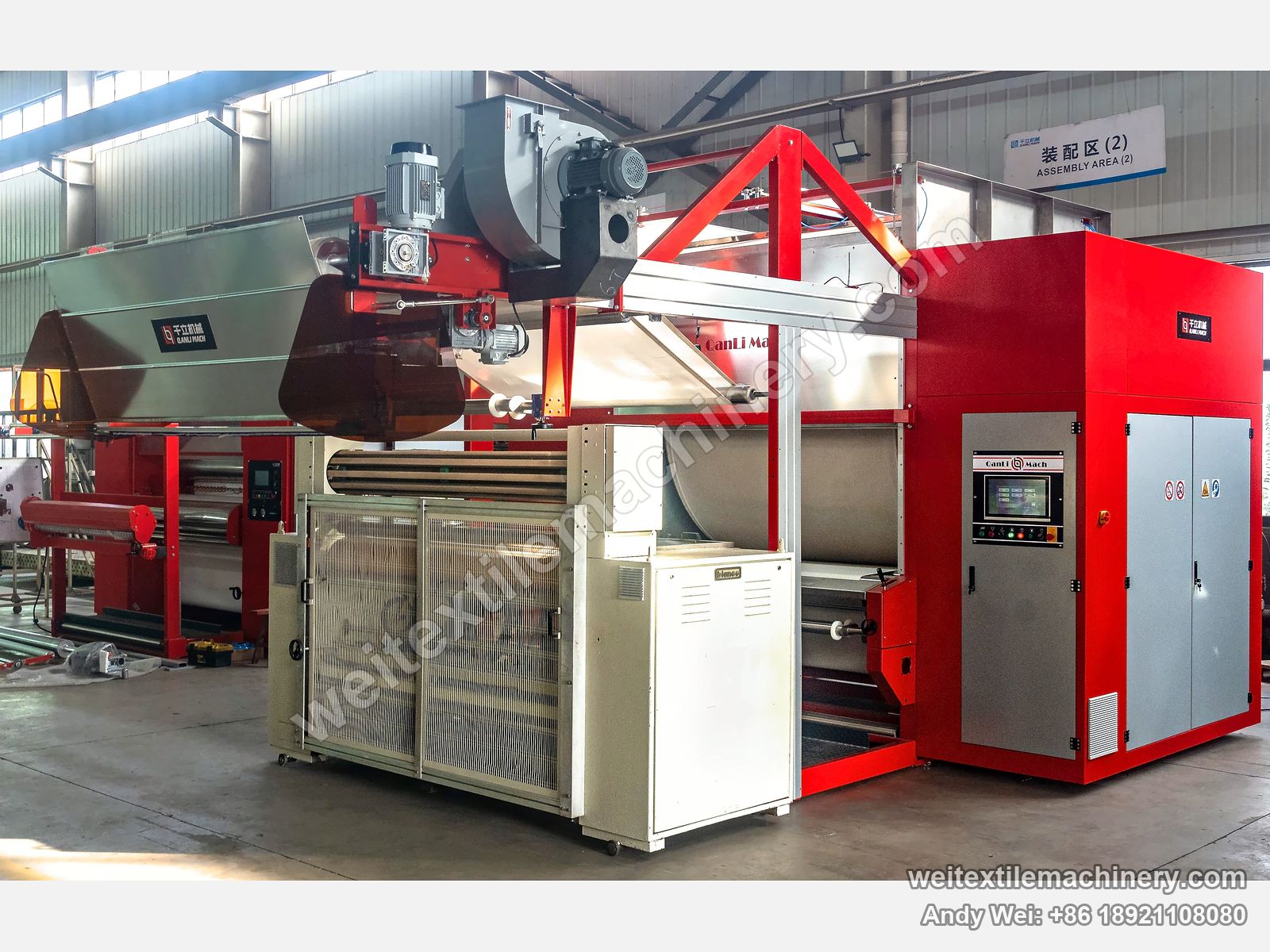
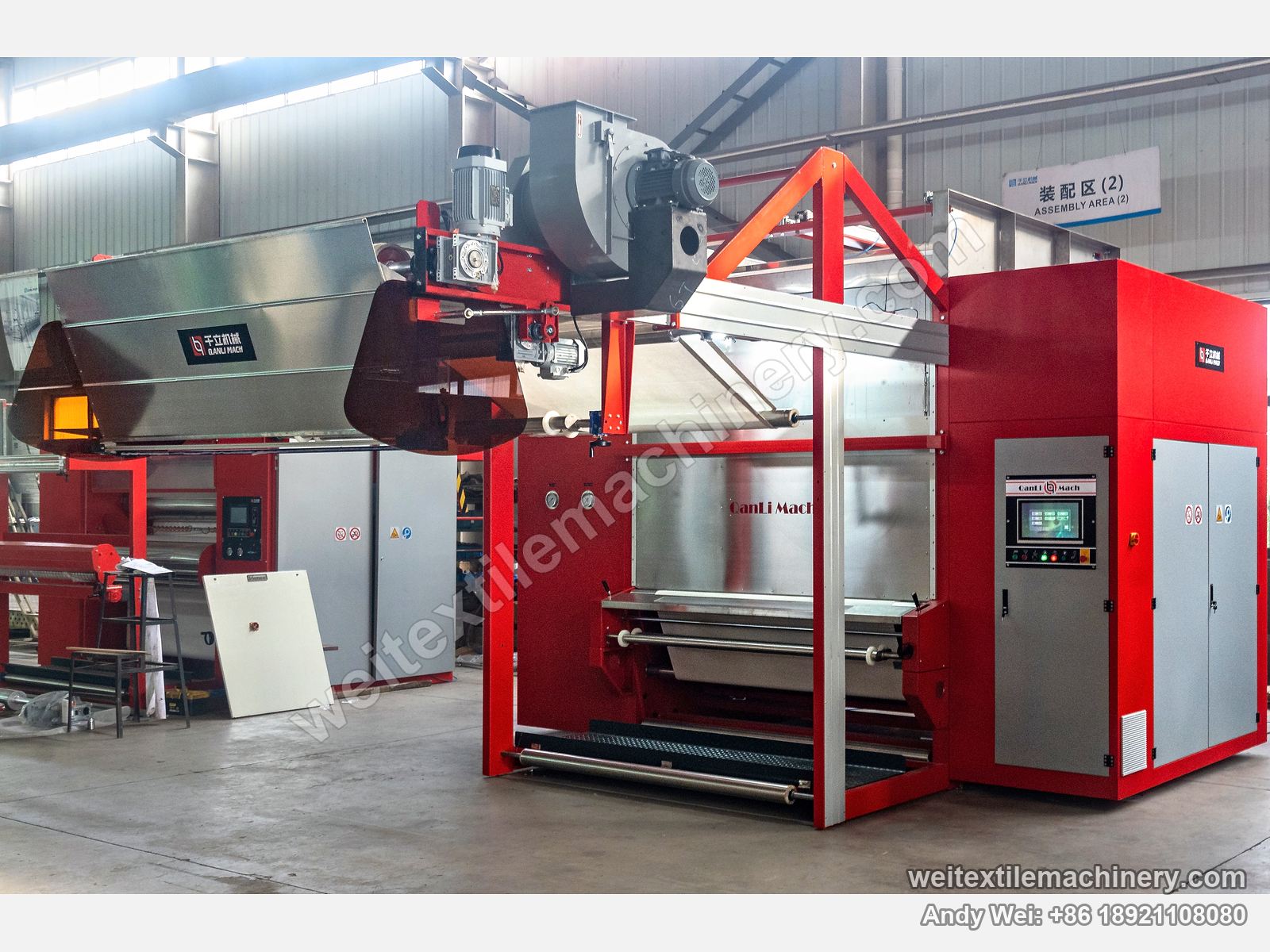
Front view, fan and motor on top
Key advantages
- Ø2000 Oversized Decatizing Cylinder — over twice the diameter of conventional cylinders, eliminating head-to-tail piece variation at its source; single loading capacity 500–1,000 m.
- QL Micro-Pressure Uniform Steaming Technology — the proprietary internal geometry reduces steam consumption at source while simultaneously eliminating condensate formation and the associated steam losses, delivering a 50%+ reduction in steam consumption through this dual effect; the micro-pressure design accelerates steam penetration, ensuring chromatically consistent results across the full fabric width with no left-centre-right shading and a deeper, fuller decatizing effect.
- Inside / Outside Bidirectional Steam Injection — steam acts on the fabric from both inside and outside the cylinder, ensuring fully synchronised, width-uniform decatizing.
- STT-Curve Process Control — wrapper A-roller, B-roller and pressing roller (C-roller) all governed by STT-curve control, precisely eliminating inner-outer layer differential effects in the fabric.
Fabric results (before / after)
Threading diagrams
QL Micro-Pressure Uniform Steaming Technology
- 50%+ reduction in steam consumption — source-level steam economy from the internal geometry, plus elimination of condensate-related steam losses; a dual reduction effect.
- Eliminates left-centre-right shading — the distinctive internal geometry ensures full-width uniform steam distribution.
- Deeper, fuller decatizing effect — the micro-pressure design accelerates steam penetration through the fabric.
- Eliminates head-to-tail piece variation — the Ø2000 oversized cylinder provides ample fabric travel and dwell.
Product overview
The WPF-JXZN-MAX redefines the performance baseline of discontinuous decatizing. Two hardware breakthroughs work in concert — the Ø2000 Oversized Decatizing Cylinder and the QL Micro-Pressure Uniform Steaming Technology — to eliminate at the source the two long-standing limitations of conventional discontinuous decatizing: left-centre-right shading and head-to-tail piece variation. The result: an exceptional dimensional stability, an extraordinary touch and a fully developed handle.
Suitable for the premium decatizing of worsted and woollen fabrics, silk, linen and other natural fibres, as well as polyester, acrylic and other synthetic constructions — a single platform covering both woven and knitted finishing requirements.
Applications
Key specifications
| Wrapper working width | 1,800 / 2,000 / 2,200 mm |
|---|---|
| Cylinder diameter | Ø 2,000 mm |
| Wrapper loading capacity | 500 – 1,000 m |
| Operating speed | 50 m/min |
| Installed power | 42 kW |
| Vacuum pump power | 15 kW (or 18.5 kW vane fan) |
| Dimensions (L × W × H) | 4,700 × 7,600 × 3,600 mm |
| Control system | Touchscreen + PLC, automated process management with recipe storage |
| Main drive | Servo-driven tension management |
Optional features
- Pin-wheel weft straightener at infeed
- Automatic fabric centring device
- Antistatic discharge unit at outfeed
- Intelligent saddle-mode plaiting unit
- Vacuum pump silencer
Full configuration notes, the complete feature list and selection advice — put together for your line and sent straight to you.
Request the full technical fileAll technical parameters and energy figures stated in this document are measured under ideal operating conditions; actual performance may vary with fabric characteristics, process settings and on-site conditions. The manufacturer reserves the right to introduce technical improvements without prior notice.
Other machines for the same station
This station can be done in more than one way. Each suits a different case — choose by your fabric and output.
Pre-owned machines for this station
Pre-owned European machines for the same station — fully rebuilt to order, and upgraded if you wish.
Common problems in dry finishing
Real questions from the mill floor — and how we answer them.
How do I choose among the four decatizing methods — discontinuous, continuous, continuous-pressure, or autoclave (KD)?
Choose a decatizing method by throughput and set depth.
How does the throughput of continuous decatizing compare with discontinuous (large-drum) decatizing, and how should I choose?
Choose by fabric and finish first, then by line pace.
What causes side-to-side color unevenness and head-to-tail piece variation after decatizing, why are continuous decatizing machines more prone to it, and does a large-drum discontinuous decatizing machine solve it?
Shade and end-to-end variation mostly come from uneven steam distribution — in a conventional continuous decatizing setup, fast fabric travel means short steam contact, and condensate dripping inside the steam-rise…
Can worsted, woollen, silk and man-made fibres all run here without fibre damage?
All of them run here: worsted and woollen wool, silk, linen and other natural fibres, polyester, acrylic and multi-fibre blends, woven and knitted alike.
The wrapper needs changing and upkeep — how much of a burden is that?
QL's WPF-JXZN-MAX decatizing machine looks after the wrapper itself.
Polishing and steam preshrinking are already done — why is decatizing still necessary, and can this step be skipped?
No, decatizing cannot be skipped.
Are a discontinuous (large-drum) decatizing machine and an autoclave/KD decatizing machine the same thing — can one replace the other?
No, a discontinuous decatizing machine and a kier (autoclave) decatizing machine are not the same, and cannot simply substitute for each other.
Is crabbing the same thing as decatising or steaming yarn?
Crabbing, decatizing and yarn steaming are three different finishing processes: yarn steaming treats yarn, crabbing sets fabric in hot water, decatizing sets it with steam.
What can the WPF-JXZN-MAX do for your line?
Tell us your fabric, weight and output — we will come back with a process proposal and a quotation.