Wool Tops Backwashing Line
WPF-MTFX
Tops Backwashing Machine · Engineered with QL Suction-and-Pressure Backwashing System + QL Vacuum-Retention Through-Flow Drying System
The machine, up close
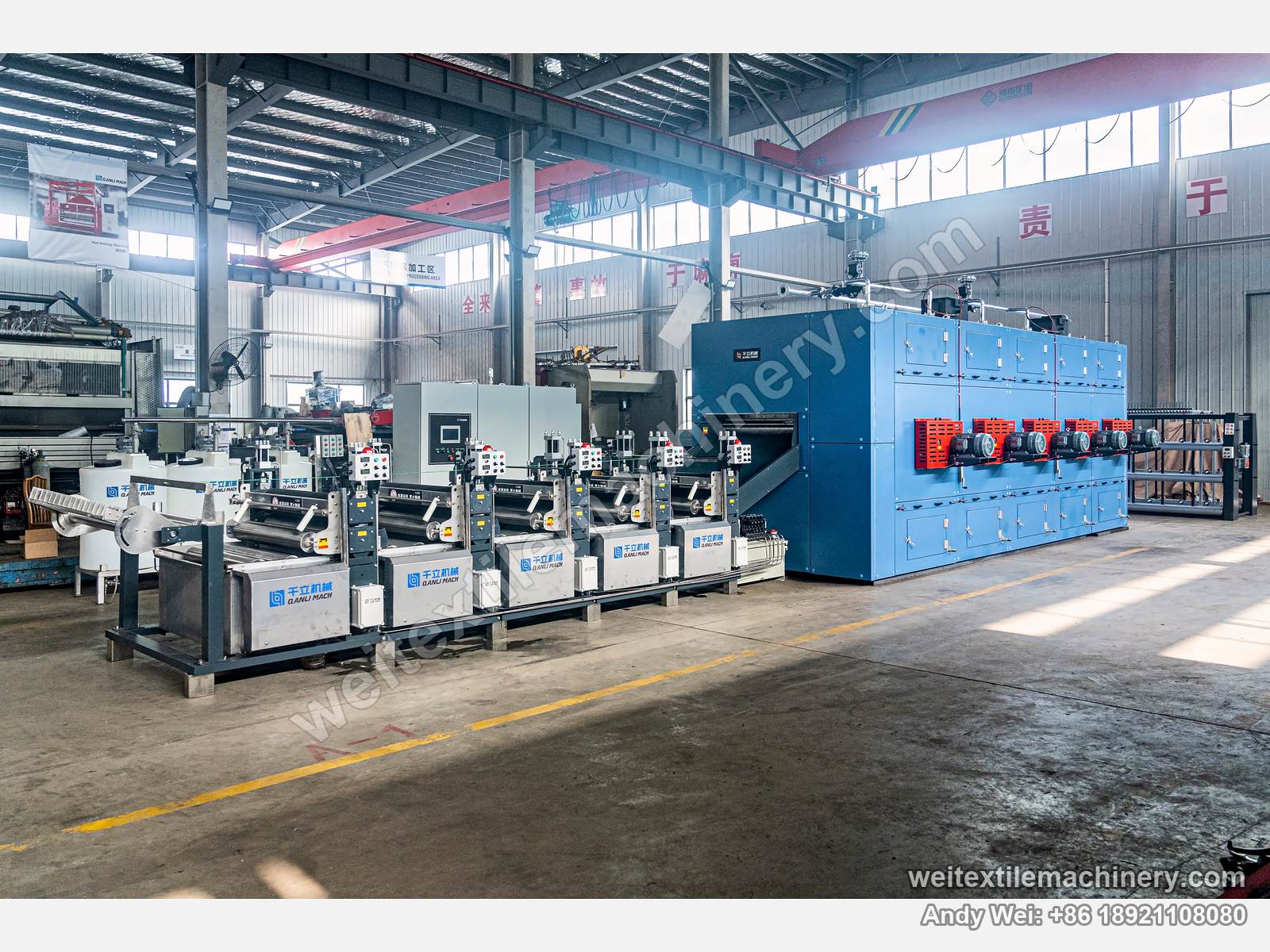
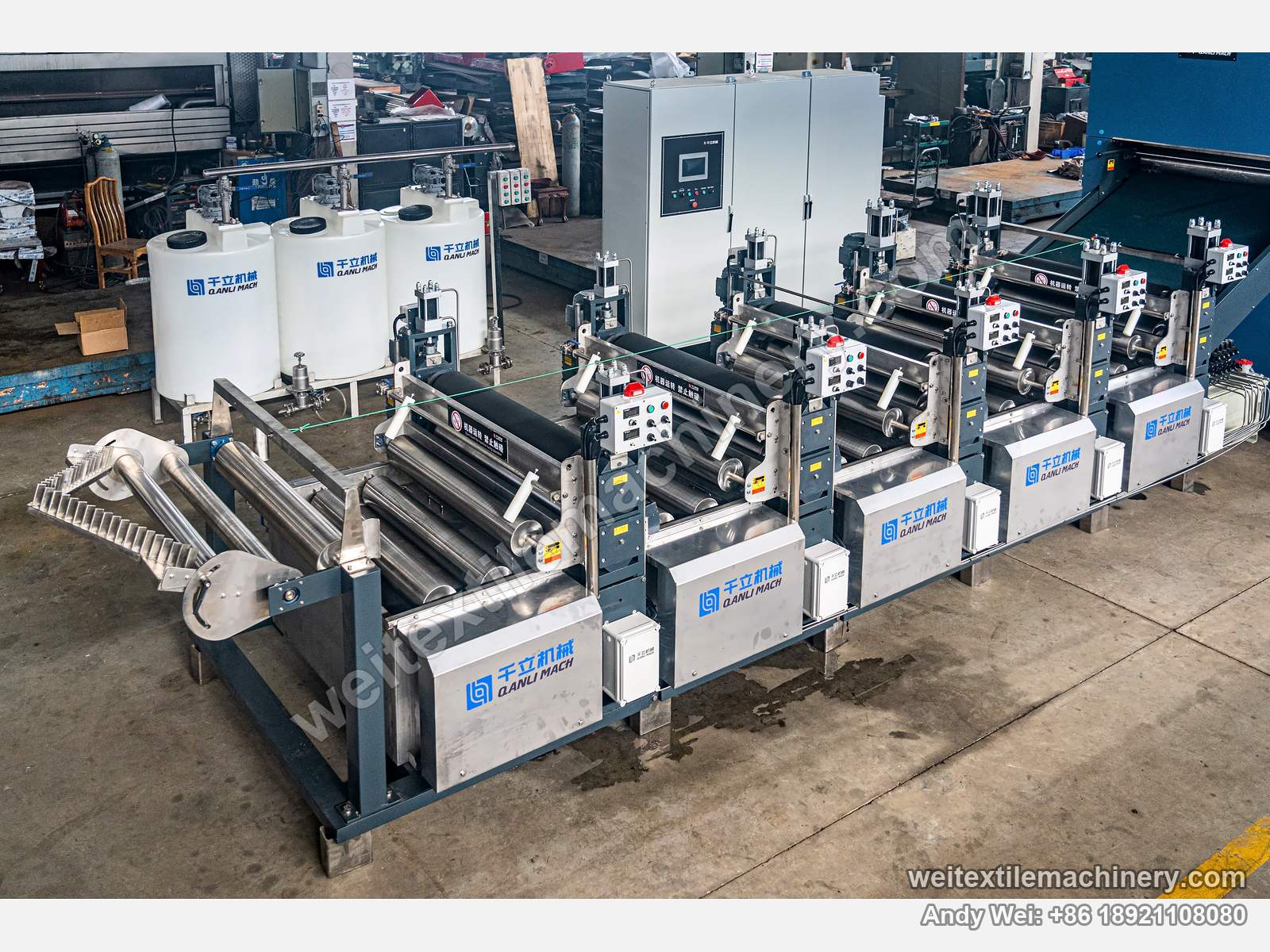
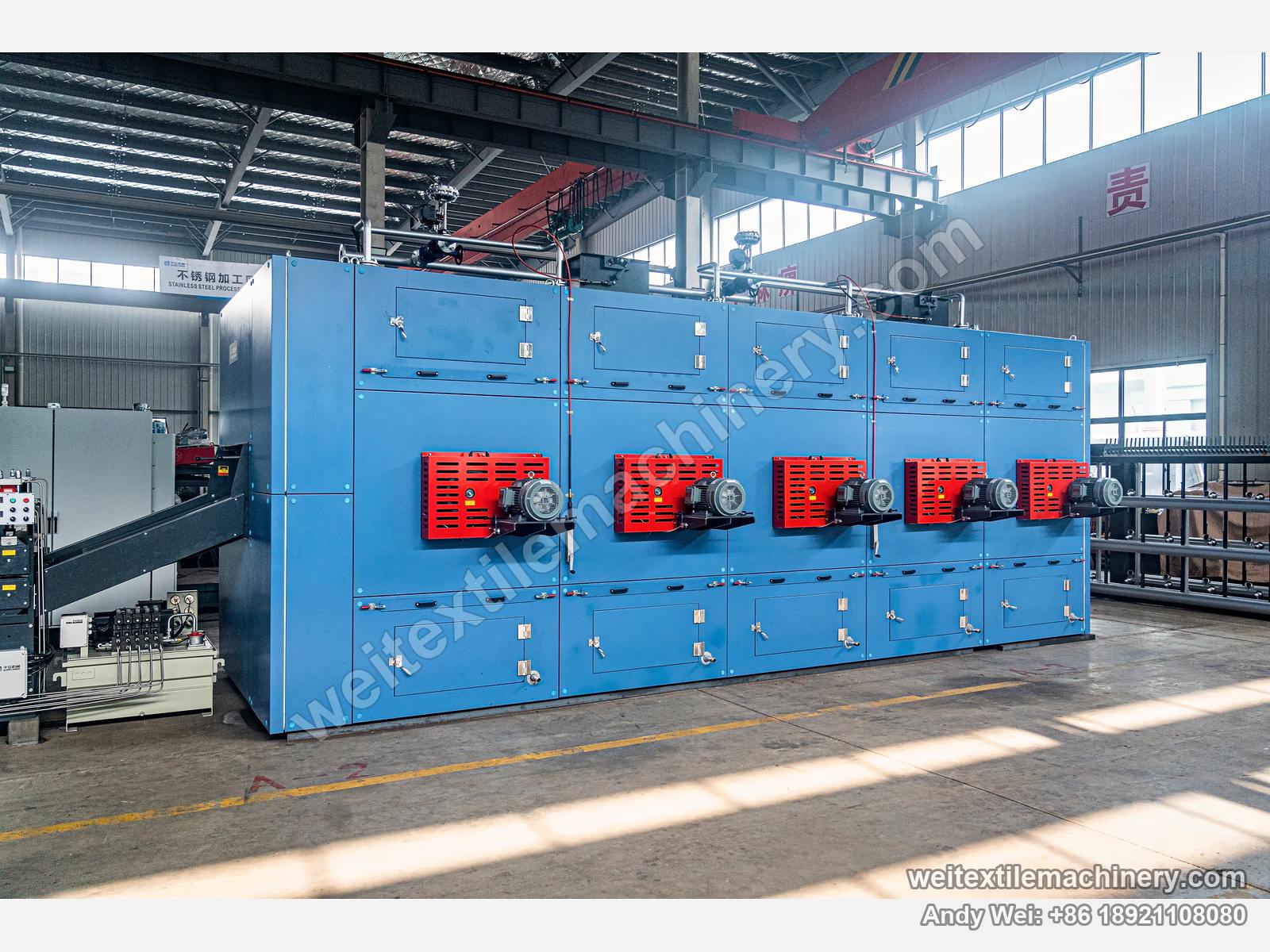
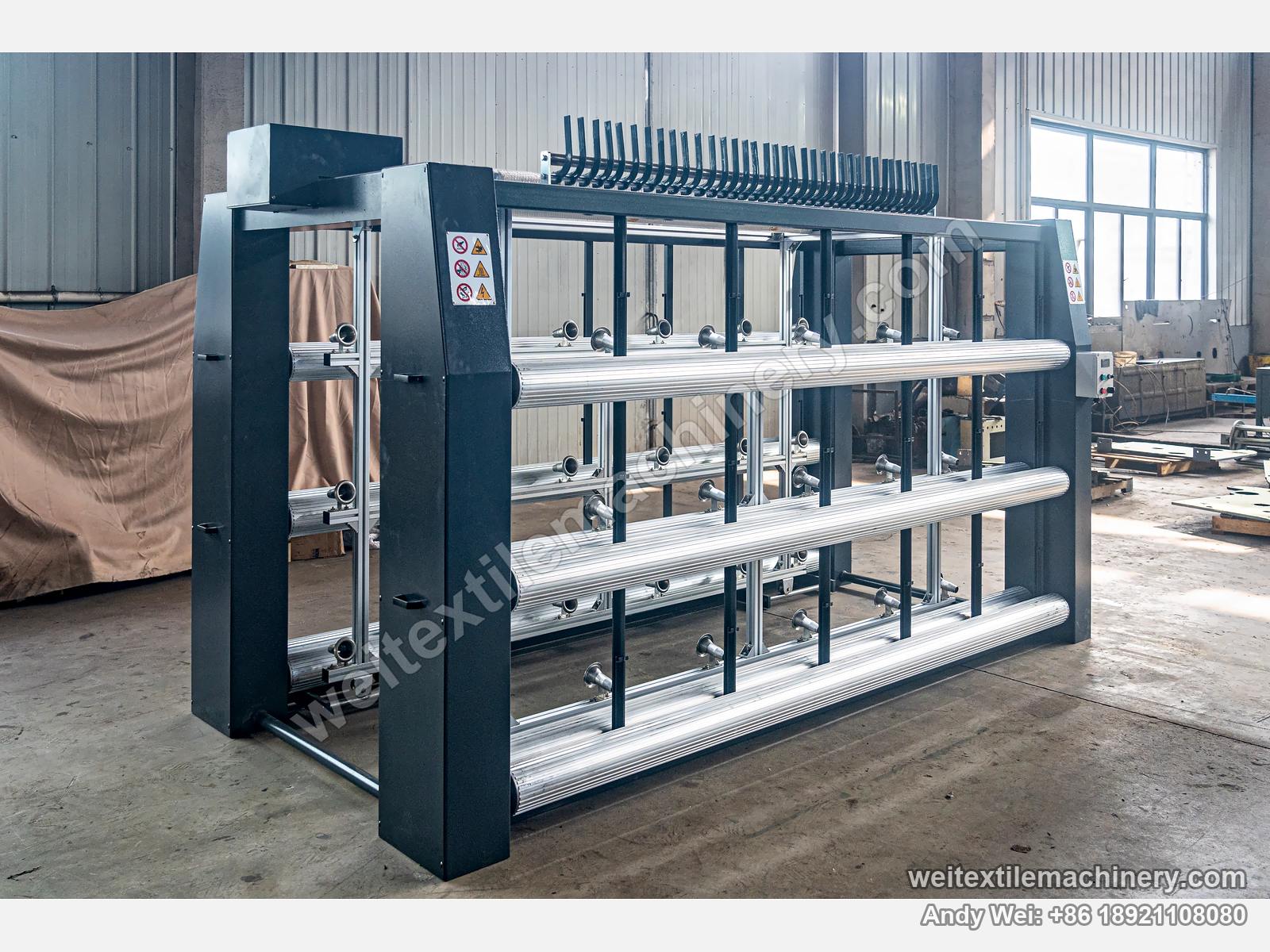
Full line, washing and drying sections
Line composition
- Creel — simplified architecture, 36 ends fed simultaneously; reduced footprint, practical-first design
- Washing Unit — driven by the QL Suction-and-Pressure Backwashing System, multi-bowl continuous scouring followed by 9-tonne heavy-pressure pre-dewatering
- Suction Drum Drying Unit — driven by the QL Vacuum-Retention Through-Flow Drying System, micro-vacuum loose retention on perforated suction drums with through-flow heated-air recirculation
- Delivery Unit — choose either WPF-PT coiling or WPF-CQ ball winding to suit the next operation
Fabric results (before / after)
Threading diagrams
QL Proprietary Systems
- QL Suction-and-Pressure Backwashing System
- Suction-Drum Configuration + Internal Liquor-Recirculation Suction Pump — the suction pump is housed inside the perforated drum, forcing washing liquor from the bowl exterior through the tops layer; loose dye and unfixed dyeing auxiliaries are thoroughly stripped, each fibre uniformly treated from start to finish
- Variable-Frequency Suction Pump + Proprietary Support-Tube Perforation Geometry — the suction pump is driven by a variable-frequency drive with infinitely variable speed; the proprietary perforation geometry on the internal support tube distributes liquor flow uniformly — washing performance is consistent across the left, centre and right of the tops layer
- Independent Multi-Motor Drive — each transmission node is driven by an independent motor; the mechanical system is simplified, single-point failures do not propagate, fault rate substantially reduced
- 9-Tonne Heavy-Duty Squeezer — squeezing force at twice the industry standard; post-backwashing moisture content is substantially reduced, compressing downstream drying energy and time in tandem
- Modular Disassembly Architecture — bowls, drums and filtration components are independently demountable by module; cleaning, servicing and maintenance are simplified
- QL Vacuum-Retention Through-Flow Drying System
- Perforated Suction Drum + In-Drum Micro-Vacuum — high-power fans extract air from inside the suction drum, generating a micro-vacuum at the drum surface; the tops are loosely retained on the drum surface — supporting subsequent through-flow heated-air recirculation while preserving bulk for downstream gilling and combing
- Upper and Lower Dual-Pressure-Chamber Air Recirculation — heated air passes through the tops layer carrying away moisture, then is drawn back into the drum forming a closed circuit; drying efficiency rises several times over parallel ventilation and impingement-jet ventilation
- Multi-Drum Material Reversal Drying — as the tops transfer from one suction drum to the next, the contact surface alternates — uniform two-sided drying
- Thermal Energy Recirculation — exhaust heated air from the preceding drum is recirculated to the following drum — thermal energy is utilised in cascade across the drying section, substantially compressing energy consumption per linear metre of tops
- Independent Electronic Drive Synchronisation per Drum — multi-drum line operation is precisely synchronised
- Inter-Drum Differential Overfeed — overfeed is generated between adjacent suction drums; tops tension drops and bulk recovers in step
- Antistatic Lap-Free Feeding Conveyor — the feeding conveyor upstream of the suction drums is built from antistatic lap-free material, eliminating static-induced lapping and its impact on drying uniformity
- Automatic Temperature Regulation — temperature uniformity of ±1.5 °C across the full working width, drying consistency precisely assured
Product overview
The WPF-MTFX is a complete continuous production line for tops backwashing — creel, washing, drying and delivery integrated across four modules. At delivery, choose either WPF-PT coiling or WPF-CQ ball winding. Dyed wool tops, acrylic tops, polyester tops and other materials in tops form — backwashing and drying are completed on a single platform.
The core process is carried by two QL proprietary systems — the QL Suction-and-Pressure Backwashing System governs the washing stage, and the QL Vacuum-Retention Through-Flow Drying System governs the drying stage. The washing stage drives down moisture content through 9-tonne heavy-pressure squeezing; the drying stage receives the material with micro-vacuum loose retention and through-flow heated-air recirculation — quality, throughput and energy efficiency delivered as one.
Working width 1,000 mm, 36 ends fed simultaneously, operating speed 10 m/min — single-line throughput marks a structural advance over conventional tops backwashing machines. Each fibre is uniformly treated from start to finish and batch-to-batch consistency is preserved — providing process-grade assurance for downstream spinning operations: lower fibre breakage, lower yarn CV, lower hairiness, no loose-dye residue.
Applications
Key specifications
| Working Width | 1,000 mm |
|---|---|
| Number of Ends | 36 |
| Operating Speed | 10 m/min |
| Temperature Uniformity | ±1.5 °C |
| Control System | Touchscreen + PLC, automatic process control with parameter storage |
Optional features
- Anti-Lapping Device + Acoustic and Visual Alarm + Automatic Speed Reduction in the Event of a Lap — anti-lapping detection installed on bowls and rollers; on lap detection, the acoustic and visual alarm trigger simultaneously and the line automatically slows
The full technical file and selection advice — put together for your line and sent straight to you.
Request the full technical fileAll technical parameters stated in this document are measured under ideal operating conditions; actual performance may vary with fibre characteristics, process settings and on-site conditions. The manufacturer reserves the right to introduce technical improvements without prior notice.
Pre-owned machines for this station
Pre-owned European machines for the same station — fully rebuilt to order, and upgraded if you wish.
Cases with this machine
Mills running the WPF-MTFX, and acceptance days.
Common problems in tops processing
Real questions from the mill floor — and how we answer them.
What is wool-tops processing equipment, and what is it used for?
Wool-tops processing equipment covers the machines that treat combed wool tops between dyeing/finishing and spinning — backwashing (washing off dyeing residues and drying), shrink-resist treatment (giving wool a…
With 36 tops running side by side, do the middle and the edges wash evenly?
The liquor flow is distributed, not left to find its own way.
Does backwashing disturb the tops and force me to re-gill them?
Bulk is preserved. High-power fans extract air from inside the suction drum to generate a micro-vacuum at its surface, and the tops are loosely retained there — bulk is kept for downstream gilling and combing.
The tops are already dyed — why wash them again instead of going straight to drying and spinning?
Dyeing leaves loose dye and unfixed dyeing auxiliaries on the tops, and those have to come off first.
How does through-flow drying differ from ordinary hot-air drying, and is it worth changing?
The difference is where the air goes.
How do I choose between the backwashing line and the shrinkproofing line — can I just buy one?
The two lines solve different problems, so it isn't a straight either-or.
What exactly does backwashing remove, and what happens if I skip it?
Backwashing strips loose dye and unfixed dyeing auxiliaries left on tops after dyeing, while evenly applying lubricant, softener and antistat before drying.
Where does backwashing sit in the production chain — before dyeing or after?
Backwashing's primary place in the chain is right after dyeing — dyed tops run through the line to wash off loose dye and residual auxiliaries and dry back to spinnable moisture.
What can the WPF-MTFX do for your line?
Tell us your fabric, weight and output — we will come back with a process proposal and a quotation.