
Continuous Crabbing and Drying Line
WPF-LXZH
Continuous Crabbing and Drying Line · Engineered with the QL Multi-Bath Immersion-Press Setting System + QL Tiered Temperature-Control Drying System
The machine, up close
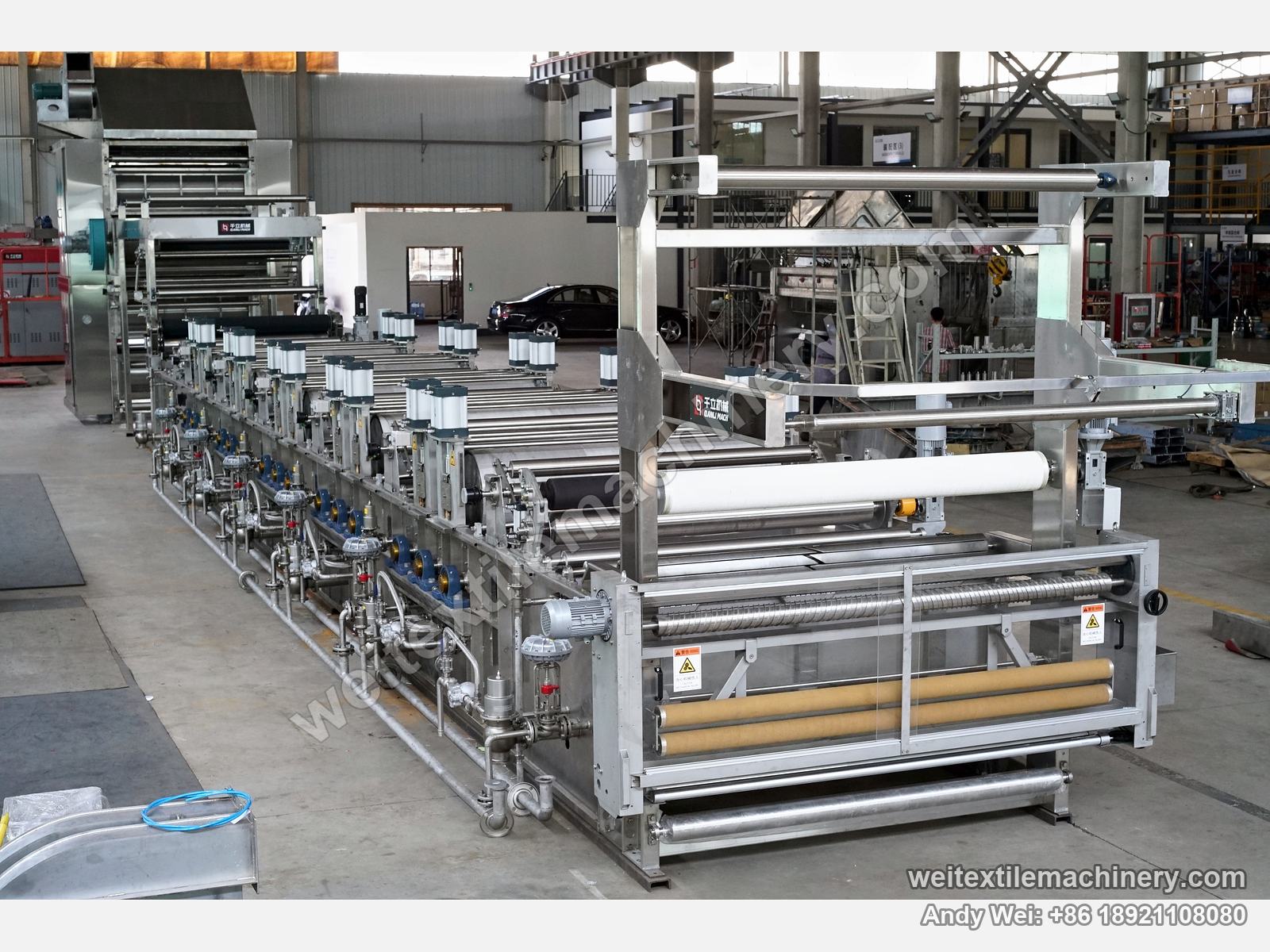
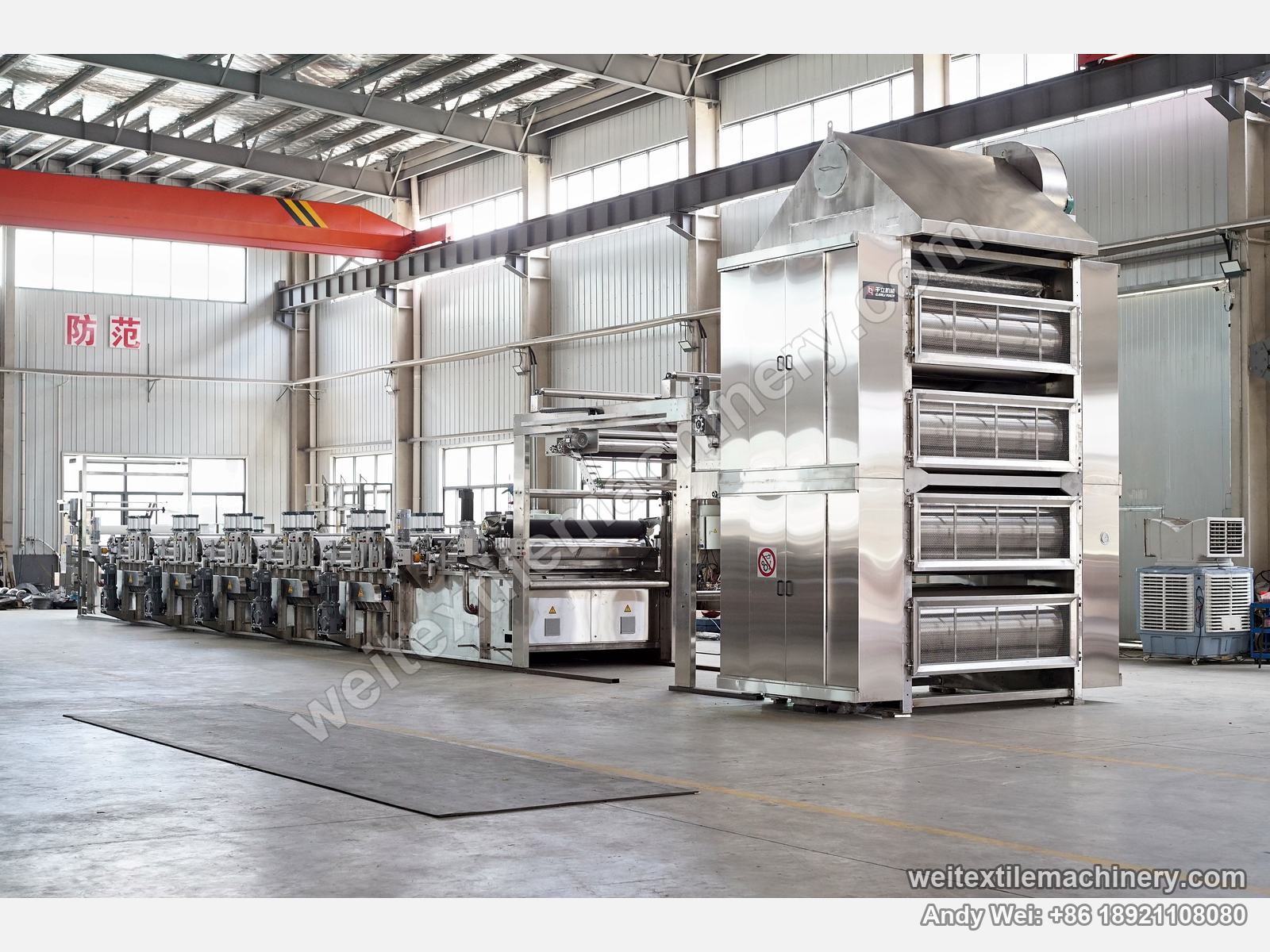
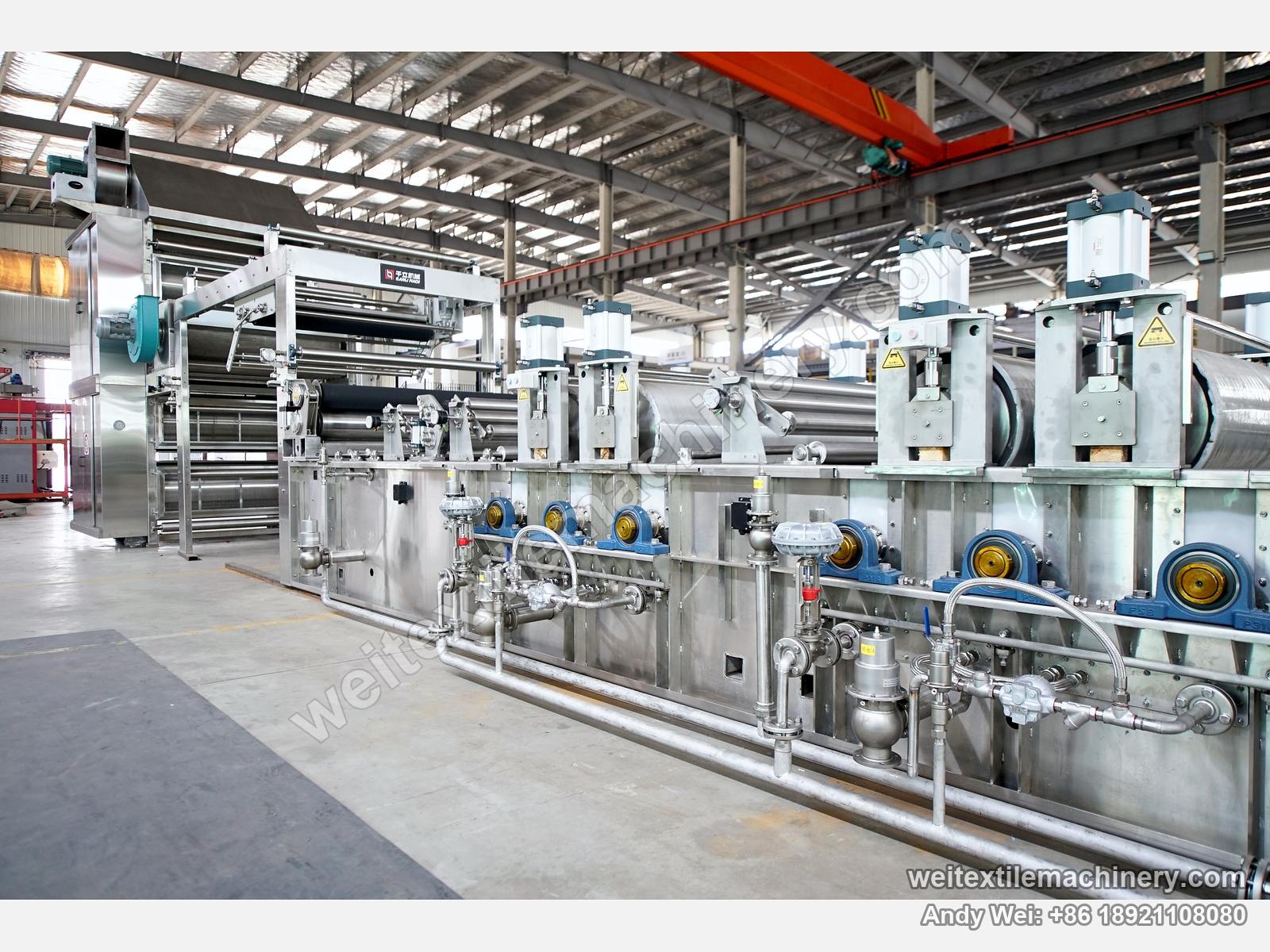
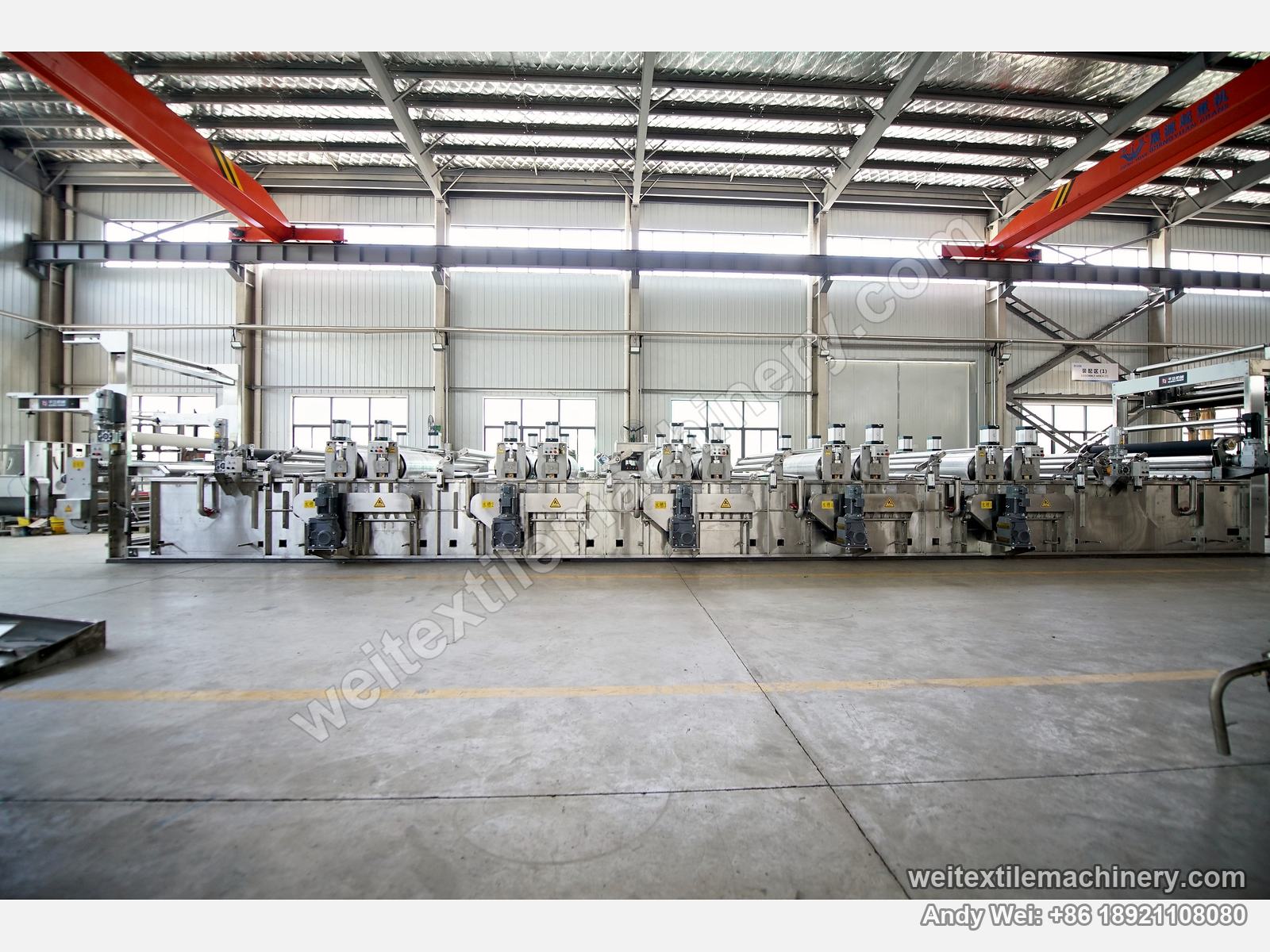
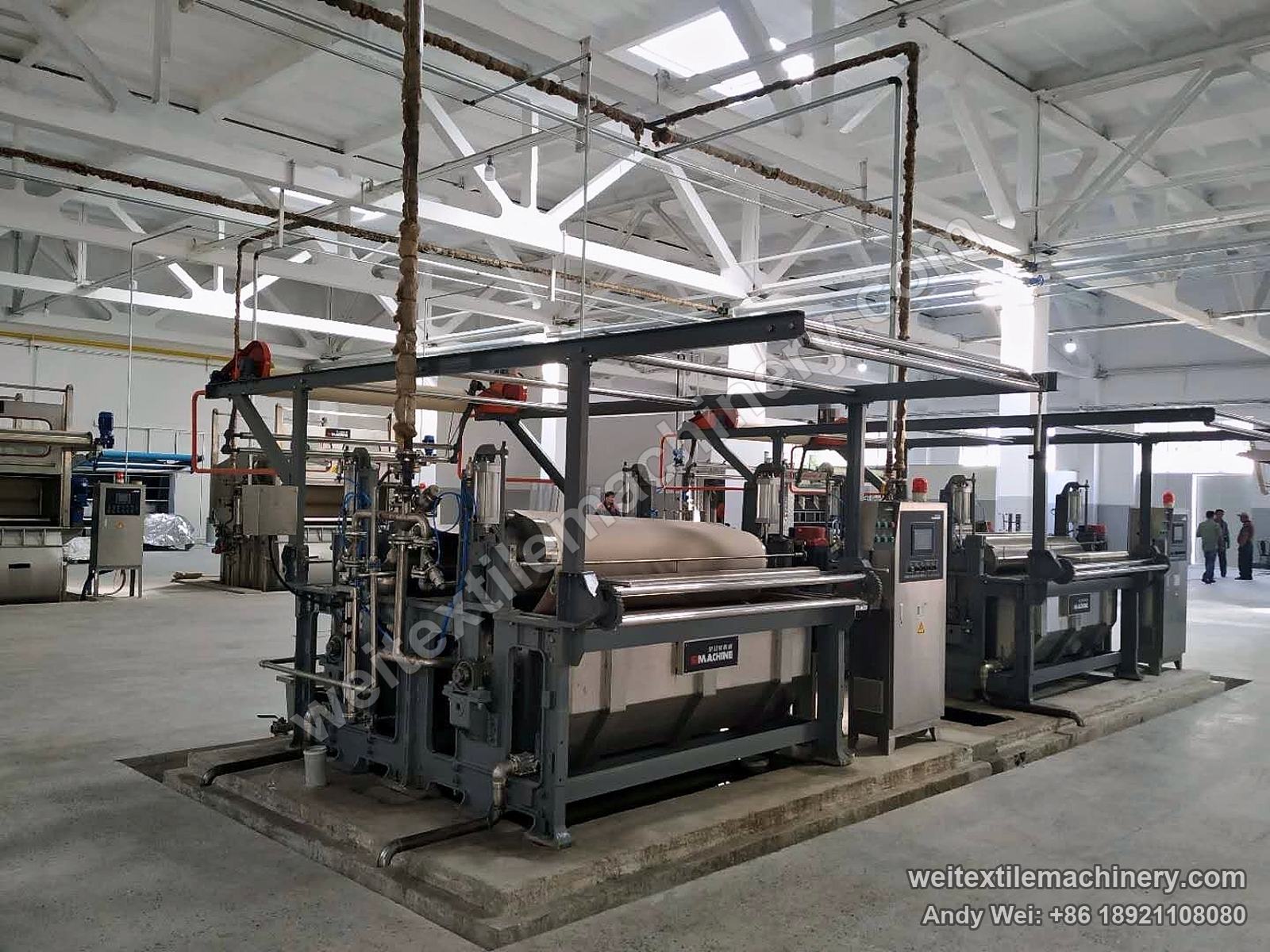
Full line, crabbing section in the foreground
Line composition
- Entry Section — tension frame, scutcher and centring device and plate expander feed the fabric in flat and centred
- Impregnation Trough — the fabric passes through the liquor twice, the trough also serving for washing; liquor expressed by the light draw squeezer returns to the trough
- Crabbing Baths (5 as standard, number configured to order) — carried by the QL Multi-Bath Immersion-Press Setting System; fabric fully immersed, each bath with a rubber-covered top roller pressing on a stainless-steel bottom roller
- Cooling Trough — with draw squeezer; the fabric is cooled in cold water
- Heavy-Duty Delivery Mangle — removes excess water before the drying section
- Cylinder Drying Tower (4 tiers, 8 cylinders) — carried by the QL Tiered Temperature-Control Drying System; two cylinders side by side on each tier, the fabric passing alternately over and under
- Perforated-Drum Suction Air-Cooling System — the dried fabric is cooled by suction air through a perforated drum before plaiting
- Single- or Twin-Station Plaiting — configured to the customer's floor space and requirements
Fabric results (before / after)
Threading diagrams
QL Proprietary Systems
- QL Multi-Bath Immersion-Press Setting System
- Fully Immersed Throughout — the fabric stays in hot liquor in every crabbing bath; moist heat acts without interruption
- Bath-by-Bath Roller Pressing — in each bath a rubber-covered top roller presses on a stainless-steel bottom roller, flattening the fabric softened in hot liquor; the rubber cover is resilient — even pressure across the full width
- Individual Bath Liquors — each bath can be charged with its own liquor, to the quality and the process
- Synchronised Tension Tracking — a vertical dancer with position sensing adjusts the line speed of each unit to the dancer position — the fabric passes every bath under controlled tension
- Double-Dip Impregnation Trough — two passes through the liquor for thorough, even pick-up, the trough also serving for washing; expressed liquor returns to the trough for reuse — lower auxiliary consumption, lower energy use
- Cooling Trough — the hot fabric is cooled in cold water — the flatness developed under moist heat is fixed as it cools
- Heavy-Duty Delivery Mangle — water removed mechanically no longer has to be evaporated on the cylinders — drying energy falls accordingly
- QL Tiered Temperature-Control Drying System
- Tiered Temperature Control — four tiers, the two cylinders on each tier forming one temperature zone; as the fabric goes from wet to dry, temperature is set tier by tier — the fabric surface is not overheated as drying nears completion
- Plate Expander on Every Tier — each tier has its own plate expander, countering weft-way contraction tier by tier — the fabric runs flat onto the cylinders, guarded against creasing and selvedge curl
- Alternate Upper and Lower Contact · Both Faces — the two faces of the fabric take turns against the cylinders, never lying on one face for long — even heating of both faces, ending the harsh handle of one-sided contact; stacked tower layout for a compact footprint and less heat loss
- PTFE-Coated Cylinders — the coating separates the metal shell from the fabric face — the face resists glazing; fibres and residual auxiliaries do not stick, cleaning is easy and cylinder life is extended
- Perforated-Drum Suction Air-Cooling System — suction inside the perforated drum draws cool air through the fabric: hot wool is still plastic, so cooling before plaiting keeps stacking creases from being set into the face — static eliminated, heat yellowing in the stack prevented
- Single- or Twin-Station Plaiting — single or twin station configured to floor space and requirements; with twin stations the plaiter switches between two delivery positions and trolleys take the fabric in turn, keeping delivery continuous
Product overview
The WPF-LXZH joins a continuous crabbing section to a cylinder drying section — the fabric enters in open width, is set in a series of crabbing baths, cooled and heavy-squeezed, dried over four tiers of cylinders and cooled by perforated-drum suction air before plaiting. Each section is complete in itself: run the two as one line, or select either on its own.
The crabbing section is carried by the QL Multi-Bath Immersion-Press Setting System — the fabric stays fully immersed in hot liquor and is roller-pressed and set bath by bath; each bath can be charged with its own liquor. The drying section is carried by the QL Tiered Temperature-Control Drying System — four tiers of cylinders, each tier with its own temperature and its own expander, both faces of the fabric taking turns against the cylinders.
Suited to the continuous crabbing and drying of worsted and woollen fabrics. Run as one line, setting and drying are completed in a single pass; selected separately, the crabbing section delivers wet fabric on to piece dyeing, wet brushing and setting or teasel raising, while the drying section takes wet fabric after hydroextraction or squeezing — or follows an existing continuous crabbing machine.
Applications
Key specifications
| Working width | 1,600 mm |
|---|---|
| Speed | 5–25 m/min |
| Crabbing baths | 5 as standard (number configured to order) |
| Drying cylinders | 8 · 4 tiers, 4 temperature zones |
| Heating | Direct steam heating (indirect heating optional) |
Optional features
- Indirect Heating — heat-exchanger coils in the bath keep steam apart from the liquor — no dilution by condensate, stable liquor concentration in every bath, steadier running near the boil
- Double-Face Brushing Unit + Stainless-Steel Dust Collector — loose fibre and debris brushed from both faces before entry, collected by the dust collector
The full technical file and selection advice — put together for your line and sent straight to you.
Request the full technical fileAll technical parameters stated in this document are measured under ideal operating conditions; actual performance may vary with fabric characteristics, process settings and on-site conditions. The manufacturer reserves the right to introduce technical improvements without prior notice.
Other machines for the same station
This station can be done in more than one way. Each suits a different case — choose by your fabric and output.
Cases with this machine
Mills running the WPF-LXZH, and acceptance days.
Common problems in wet finishing
Real questions from the mill floor — and how we answer them.
Should I choose batch crabbing (WPF-ZN) or continuous crabbing (WPF-LXZH) — and is continuous crabbing deep enough?
Both routes deliver a genuine permanent set — the difference lies in production mode and in how depth of set is controlled.
Why must crabbing come before rope scouring or dyeing?
Pre-setting pays off downstream: crabbing before rope scouring and dyeing cuts shrinkage and fuzzing in the stages that follow, the weave staying defined.
For drying, should I use conventional drying equipment or WPF-LXZH's continuous drying section (cylinder-type)?
Both work — it's a choice between adding QL's WPF-LXZH drying section or keeping the drying equipment you already run, not one replacing the other by default.
Can wool be dried on cylinders? Won't the face glaze and the handle turn harsh?
Yes. Tiered temperature control, PTFE-coated cylinders and alternate-face contact work together to eliminate the glazed face and harsh handle that conventional cylinder drying can leave on wool: temperature is set…
Do the two sections have to be bought and run together?
No. Each section is complete in itself: run the two as one line, or select either on its own.
Why five baths rather than one large one?
Each bath can be charged with its own liquor, to the quality and the process, and in each bath a rubber-covered top roller presses on a stainless-steel bottom roller, flattening the fabric softened in hot liquor bath…
How much floor space does the WPF-LXZH continuous line need — will it fit our workshop?
WPF-LXZH's footprint depends on the exact configuration, so there's no single number to quote.
Why is the fabric air-cooled after drying, before plaiting?
Because hot wool is still plastic.
What can the WPF-LXZH do for your line?
Tell us your fabric, weight and output — we will come back with a process proposal and a quotation.