
Vacuum Yarn Steaming Autoclave
WPF-ZS
Yarn Steaming Autoclave · Engineered with the QL Vacuum-Convection System
The machine, up close
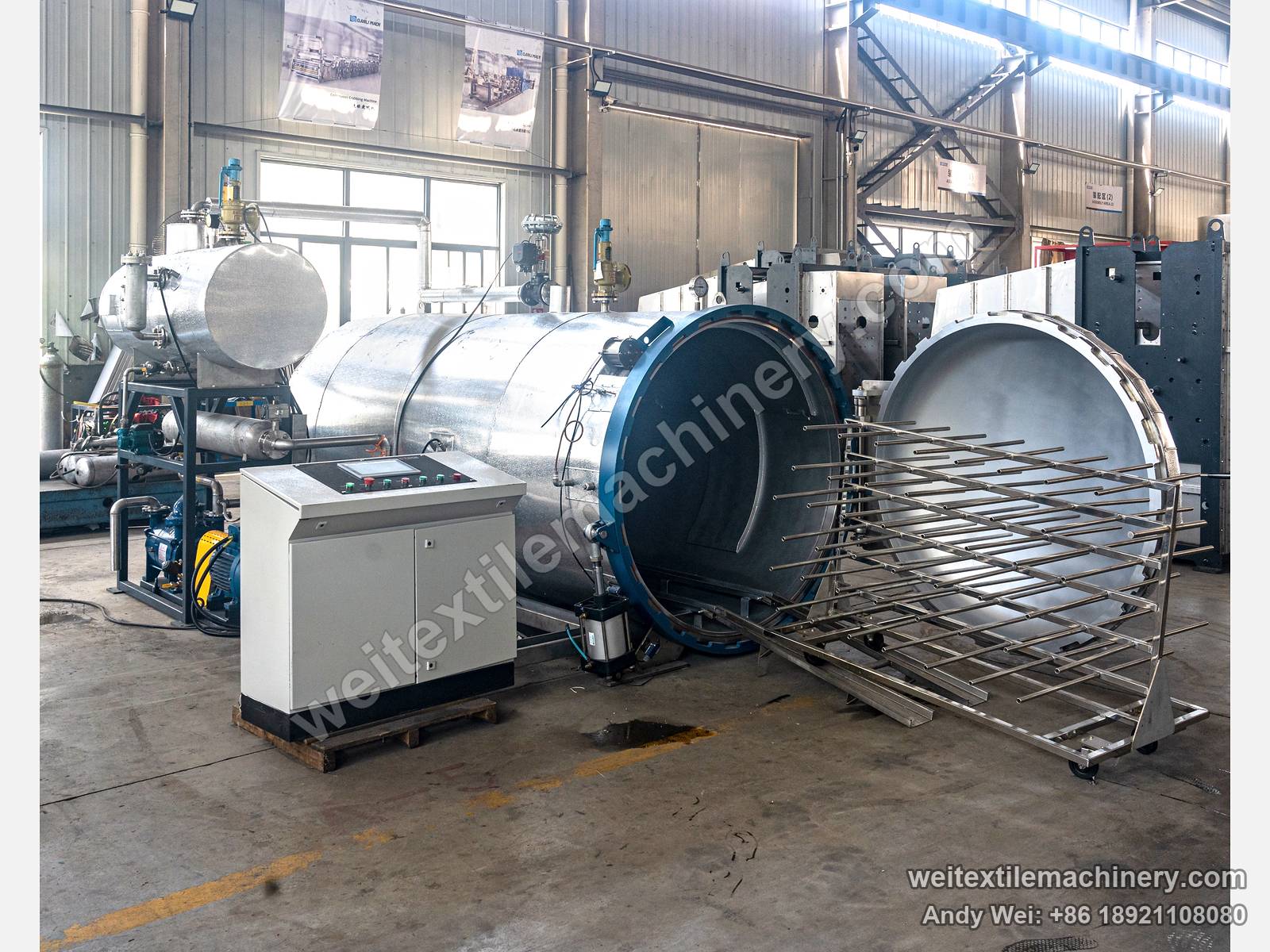
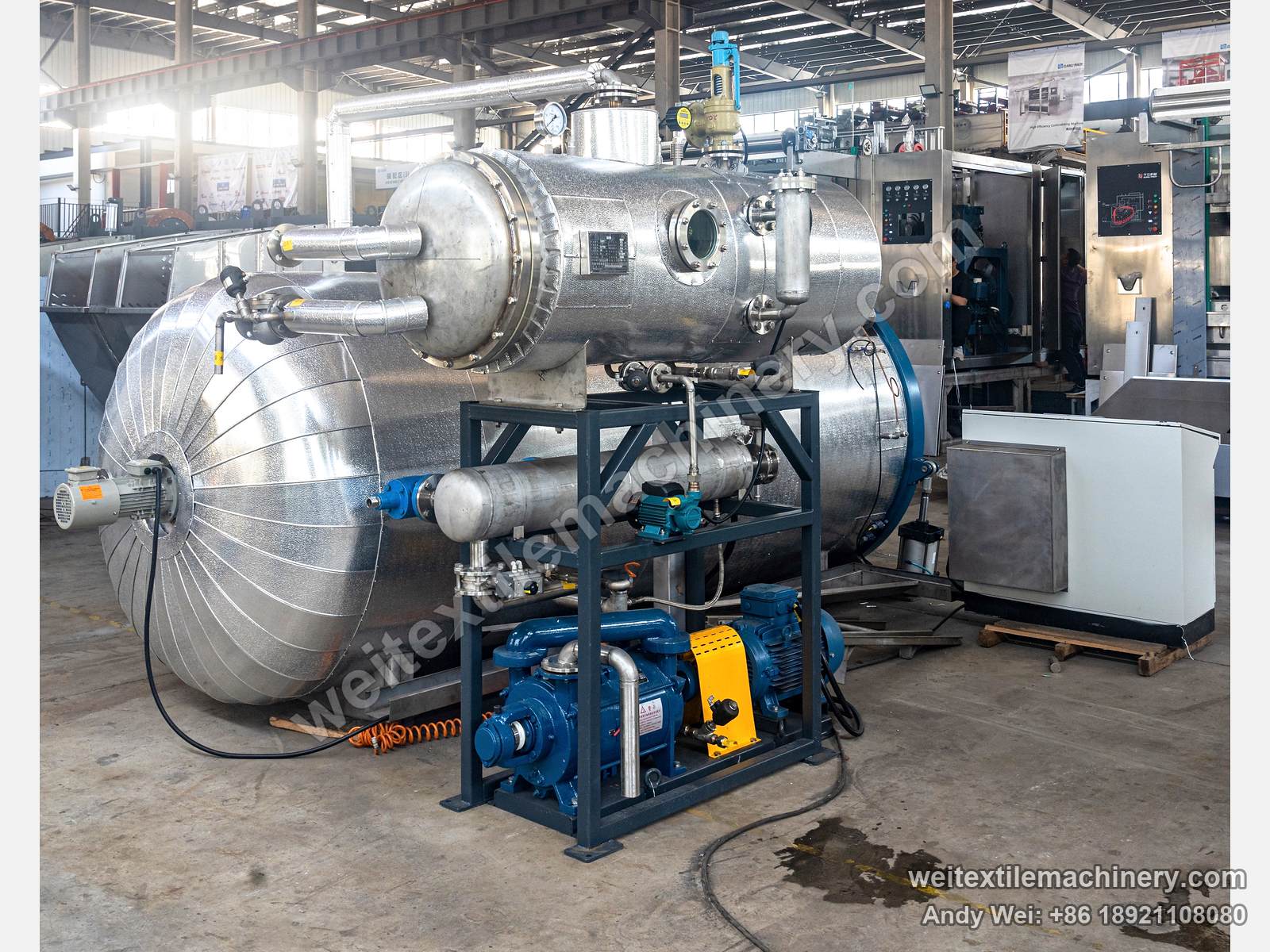
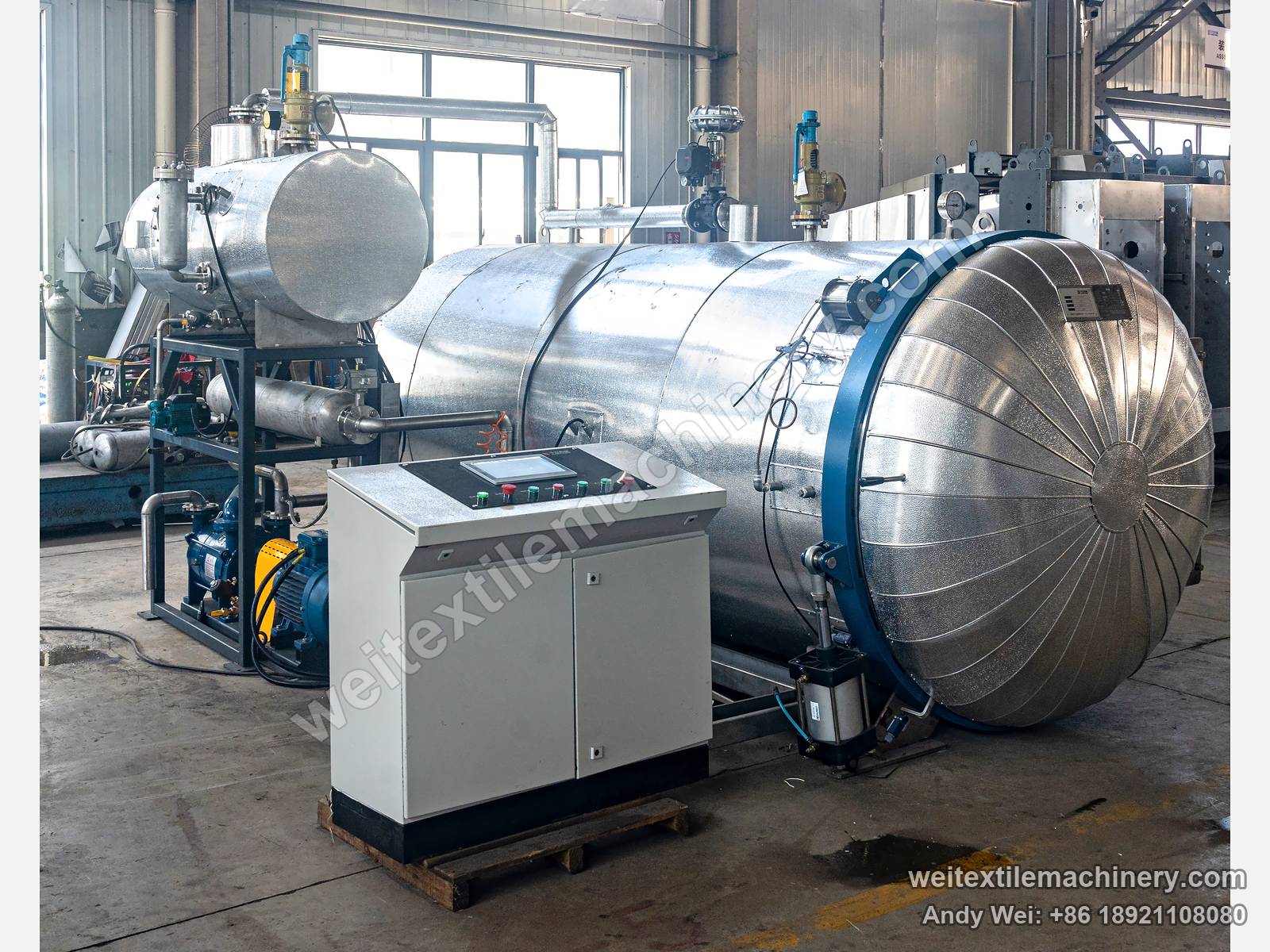
Front view, yarn rack trolley at the opening
Key advantages
- QL Vacuum-Convection System — a two-stage vacuum pump establishes process vacuum, a fan drives steam circulation, and independent channels distribute steam evenly: three mechanisms in concert — steam permeates the yarn core, no temperature differential within the chamber, the yarn surface free of water marks, setting uniform and stable
- Material-Adaptive Process — vacuum level, holding temperature, holding time and number of cycles are set to the fibre and process requirement, stored and recalled by recipe
- Evaporator-Generated Saturated Steam — an external steam source heats the evaporator, which produces stable saturated steam delivered through the independent channels by fan circulation
- Yarn Trolley Loading — approximately 250 packages per trolley, two trolleys per chamber; trolley and packages are pushed in and drawn out as a unit
Fabric results (before / after)
Threading diagrams
QL Vacuum-Convection System
- Two-Stage Deep Vacuum — the chamber is drawn to 95% vacuum (residual pressure ≈ 50 mbar), clearing air from the yarn interior, fibre interstices and tube dead zones; with this poorly-conducting air removed, saturated steam permeates pinpoint to the innermost yarn — uniform conditioning from outside to inside, even in high-density packages
- Vacuum Flash Dewatering — under vacuum the boiling point of water falls sharply; the final stage requires no high temperature, and residual moisture in the yarn vaporises near room temperature and is drawn off; dewatering and cooling proceed together, out-of-chamber humidity is uniform, with no water-stained yarn — cooling and drying time is substantially shorter than in atmospheric steaming
- Fan-Driven Uniform Circulation — a fan drives saturated steam in continuous vertical circulation, entering the main cavity evenly through independent channels rather than striking the yarn directly; no temperature differential, balanced circulation, the yarn surface free of water marks — consistent setting from inside to outside within the batch
- ① First Evacuation · Air Removal and Pre-Conditioning — drawn to 95% vacuum, clearing cold air from the yarn interior and tube dead zones; penetration resistance is removed and the steam path through the fibre interstices is clear
- ② Constant-Temperature Setting · Main Stage — saturated steam is admitted and, under vacuum, permeates to the innermost yarn; temperature-sensitive fibres run a low-temperature band (e.g. 80 °C), relieving spinning-induced internal stress and preventing fibre yellowing and strength loss
- ③ Second Evacuation · Flash Dewatering — after the constant-temperature stage the chamber is evacuated again; surplus condensate within the package vaporises and is drawn off; dewatering and cool-setting proceed together, out-of-chamber humidity is uniform
- ④ Pressure Recovery · Unloading — outside air is admitted to equalise pressure, completing the cycle for door opening and unloading
Product overview
The WPF-ZS performs yarn setting through the QL Vacuum-Convection System. The chamber is drawn to process vacuum, steam permeates to the yarn core, and a fan drives continuous steam circulation until chamber temperature is uniform. Setting is consistent from core to surface.
Steam enters the chamber evenly through independent channels rather than impinging directly on the yarn — the yarn surface remains free of water marks. For water-mark-sensitive qualities such as white yarns, printed tops and high-twist yarns, colour, whiteness and twist stability are preserved throughout the process.
The WPF-ZS is suited to the twist-setting of cotton, wool, acrylic, elastane and multi-component blended yarns, and equally to rapid moisture regain, yarn bulking, filament and tow thermosetting, Vigoureux print fixing and disinfection. Each material calls for its own vacuum level, temperature and number of cycles — process parameters are set to requirement.
Applications
Key specifications
| Chamber Dimensions | Internal diameter 1,500 mm × working length 3,300 mm |
|---|---|
| Loading Capacity | 500 kg |
| Max. Working Pressure | 2.5 bar (138 °C) / 3.0 bar (142 °C) / 4.0 bar (151 °C) |
| Max. Vacuum | 95% vacuum (residual pressure ≤ 50 mbar) |
| Vacuum System | Two-stage vacuum pump + steam ejector |
| Heating Method | Evaporator-generated saturated steam · fan circulation · independent-channel distribution |
| Process Cycle | Single / double cycle, set to material and process requirement, recipe-stored |
| Control System | Touchscreen + PLC, process-curve storage and recall |
Full configuration notes, the complete feature list and selection advice — put together for your line and sent straight to you.
Request the full technical fileAll technical parameters stated in this document are measured under ideal operating conditions; actual performance may vary with yarn characteristics, process settings and on-site conditions. The manufacturer reserves the right to introduce technical improvements without prior notice.
Wool-finishing machines used together on the same route
On the process route these wool-finishing machines sit on the same branch as this one and run in sequence — together they complete the step.
Pre-owned machines for this station
Pre-owned European machines for the same station — fully rebuilt to order, and upgraded if you wish.
Common problems in yarn steaming
Real questions from the mill floor — and how we answer them.
What does a yarn steaming machine do, and why does yarn need to be steamed?
A yarn steaming machine sets twist and evens out moisture regain in yarn: it releases the internal stress built up during spinning and twisting so the yarn unwinds cleanly instead of kinking, while bringing package…
How does a vacuum yarn steaming machine work?
A vacuum yarn steaming machine works in four steps.
What is a (vacuum) yarn steaming machine / yarn conditioning autoclave?
A vacuum yarn steaming machine — also called a yarn conditioning autoclave — is a sealed pressure vessel that treats packages, hanks or wool tops with controlled wet heat: air is evacuated first, then saturated steam…
For white yarn and printed tops, will steaming leave marks?
No. Steam enters the chamber evenly through independent channels instead of impinging on the yarn, so the surface stays free of water marks.
After printing on the tops, how is the colour fixed?
Colour on printed tops is fixed by steaming: right after vigoureux printing, the top goes into a steaming unit and is held under saturated steam, which sets the dye into the fibre; temperature and holding time depend…
Why will an ordinary steam box not do — why is vacuum needed?
Air is a poor conductor of heat; until it is cleared, steam does not reach the yarn core.
Can cotton, wool, acrylic and elastic yarns share one machine, and how do the settings differ?
Yes, one machine. Cotton, wool, acrylic, elastane and multi-component blended yarns are twist-set in the same chamber; what changes is the recipe — vacuum level, holding temperature, holding time and number of cycles…
Twist setting and conditioning — do those need two separate machines?
One machine covers both. The same WPF-ZS runs twist-setting, rapid moisture regain and yarn bulking, filament and tow thermosetting, Vigoureux print fixing and disinfection.
What can the WPF-ZS do for your line?
Tell us your fabric, weight and output — we will come back with a process proposal and a quotation.