
Fabric Polishing Machine
WPF-TG
Premium Polishing Machine · Engineered with the QL Wide-Contact Deep-Polishing Roller System · 1,800 / 2,000 / 2,200 mm working widths
The machine, up close
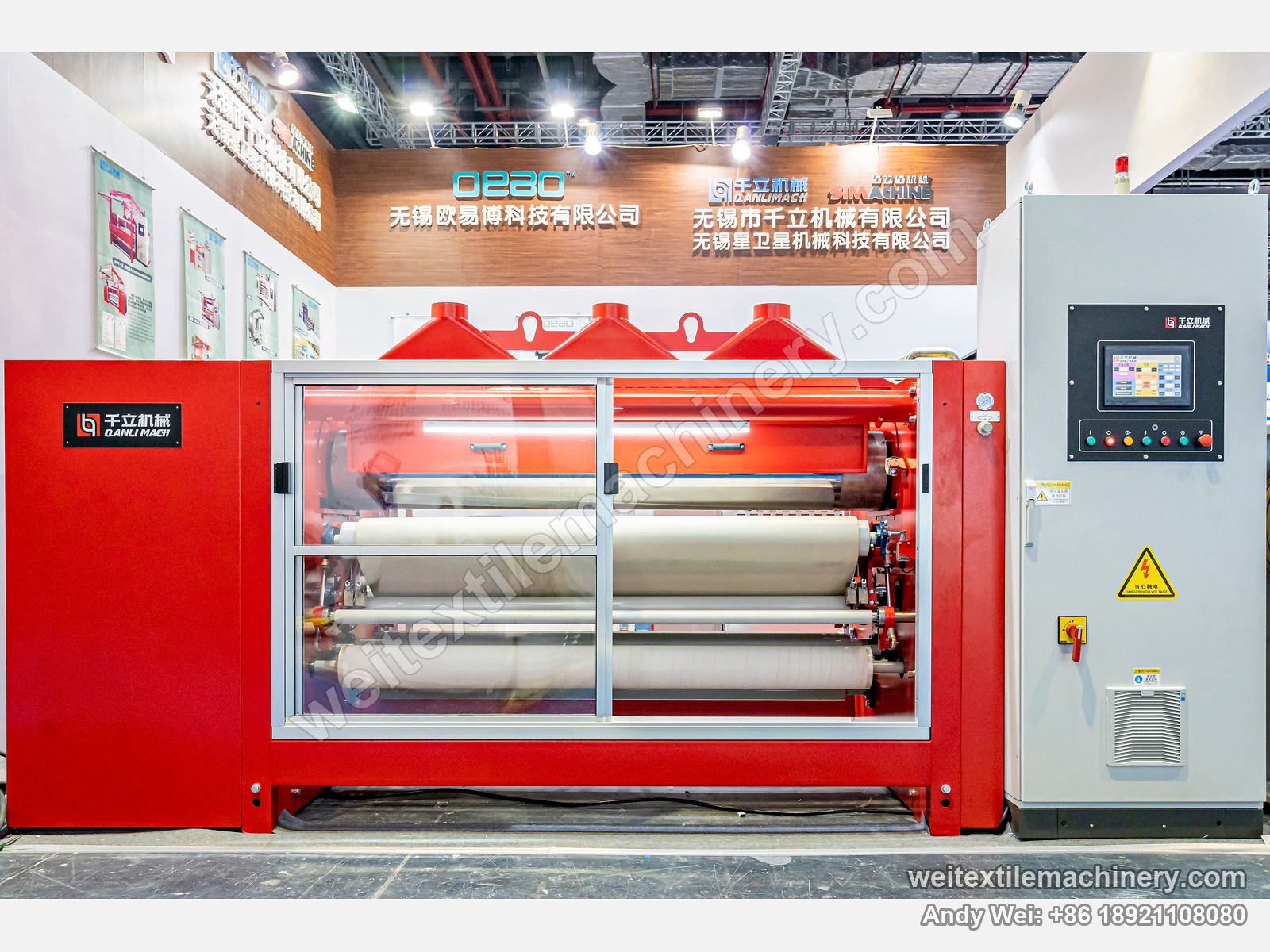
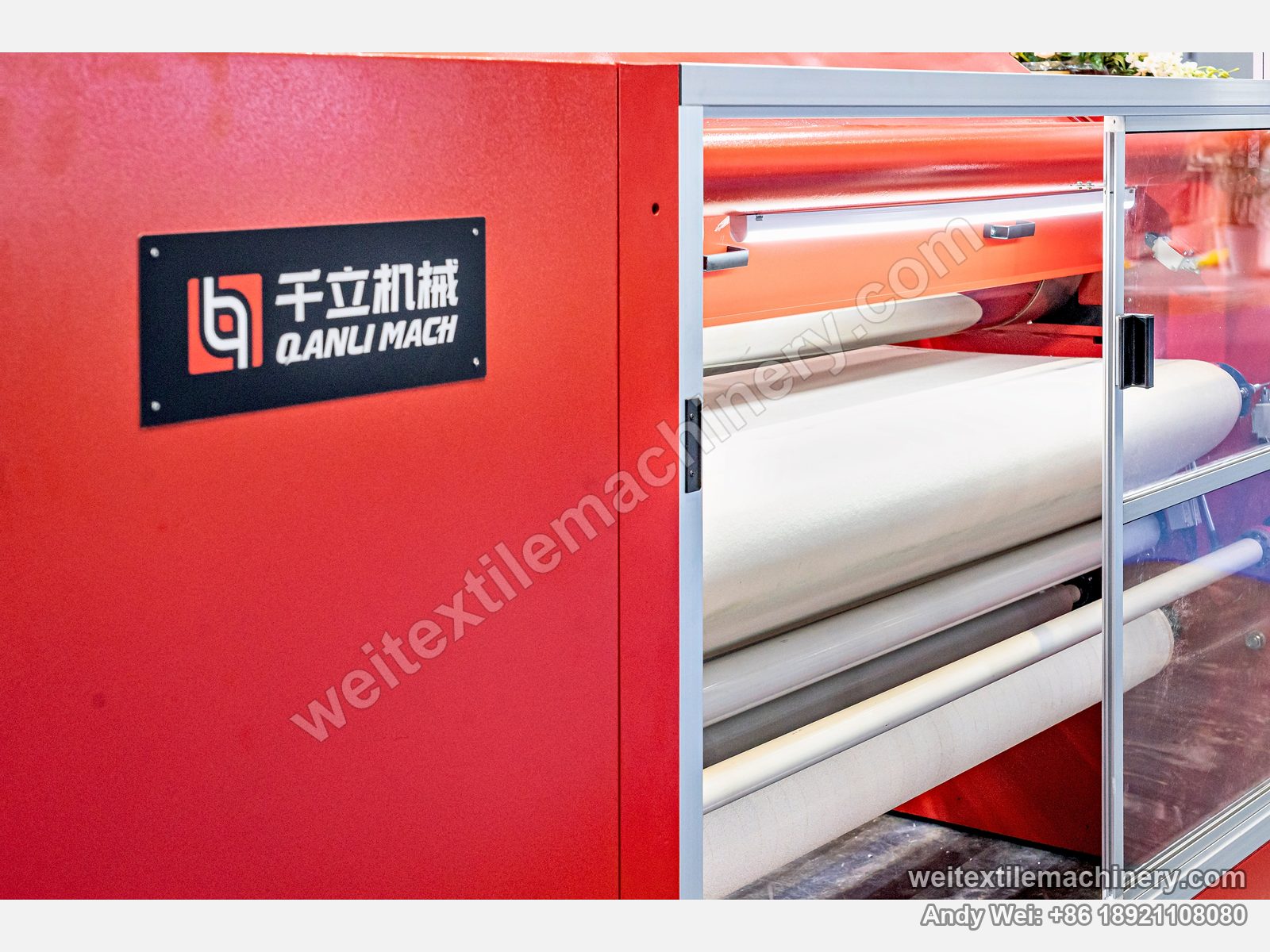
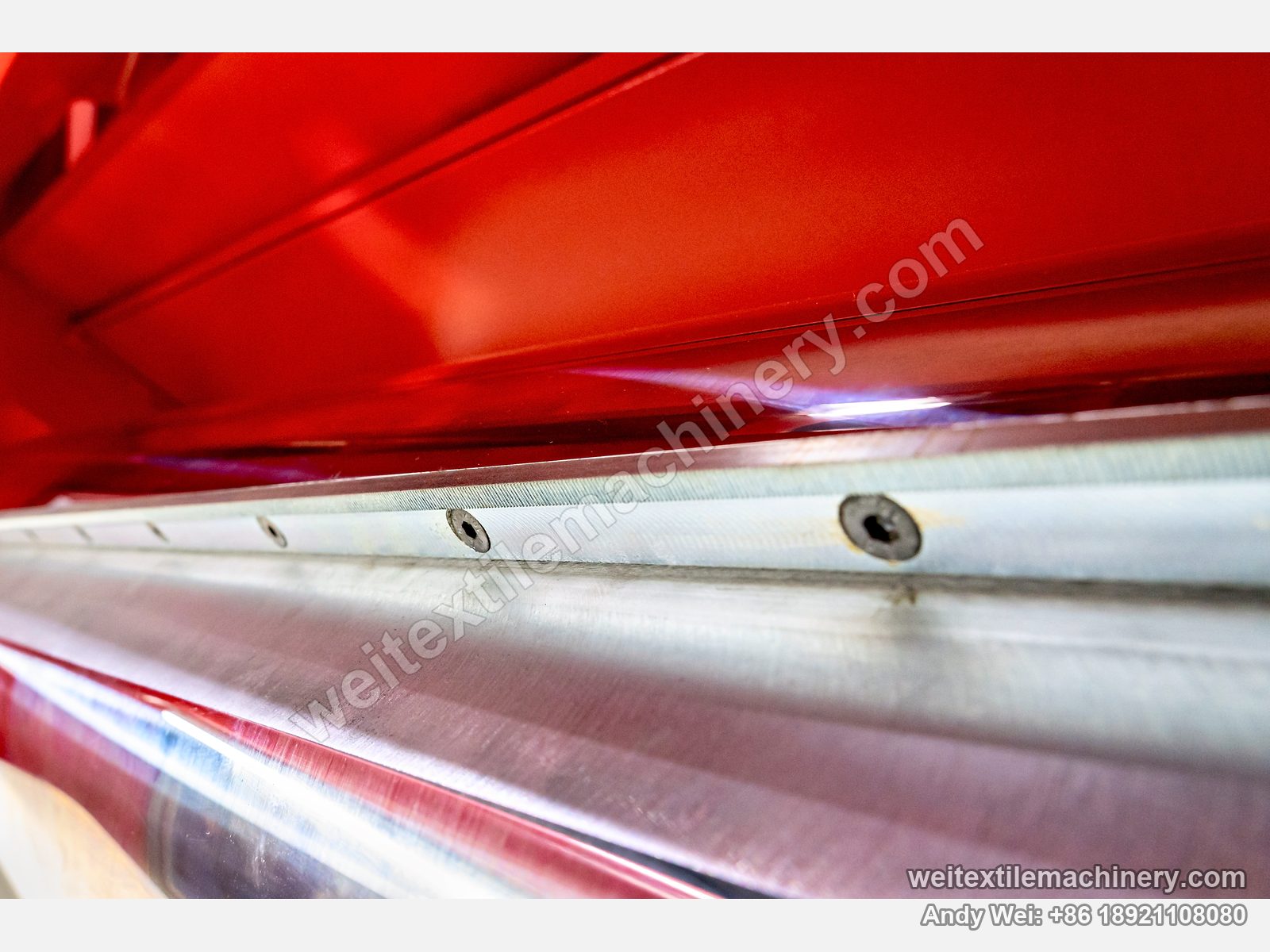
Front view at an exhibition stand
Key advantages
- Four spiral grooves and four combing teeth on the polishing roller · 1∶1 synchronised configuration — the teeth straighten the pile to its root, the heated roller follows with the polishing pass: one process, deep and lasting lustre
- Twin fabric-carrier-belt felt rollers · process-adjustable wide-contact zone — the fabric-to-roller contact area is precisely tunable to the process requirement; the maximum contact area substantially exceeds that of conventional domestic polishing machines, delivering deeper lustre and a more refined polishing result
- Twin-roller parallel felt-blanket centring — synchronised twin-roller action for fast, responsive correction; eliminates at the root the felt-blanket flaring inherent to single-roller centring systems, substantially extending blanket service life
- Electrically heated roller · twin-probe full-width closed-loop temperature control — primary and secondary probes monitor in parallel for precise, uniform temperature across the entire working width; touchscreen-driven independent regulation prevents the lustre variation caused by local hot or cold spots
Fabric results (before / after)
Threading diagrams
QL Wide-Contact Deep-Polishing Roller System
- 1∶1 groove-and-tooth roller surface — four spiral grooves and four combing teeth alternate across the roller; the teeth straighten the pile to its root, the heated roller follows with the polishing pass — one process, deep and lasting lustre
- Twin fabric-carrier-belt felt rollers · process-adjustable wide-contact zone — the fabric-to-roller contact area is precisely tunable to the process requirement; the maximum contact area substantially exceeds that of conventional domestic polishing machines — a wider heat-and-pressure footprint delivers deeper lustre, more stable pile and broader stylistic latitude
- Twin-roller parallel felt-blanket centring — single-roller centring systems chronically cause felt-blanket flaring, accelerated wear and shortened service life; the QL twin-roller synchronised structure removes the cause at its source — substantially extending blanket service life
Product overview
The WPF-TG is engineered for the polishing of woollen fabrics. Its polishing roller carries four spiral grooves and four combing teeth in a 1∶1 synchronised configuration — the teeth comb each fibre straight to its root, then the heated roller surface delivers the polishing pass. One process. Deep, lasting lustre.
The fabric-to-roller contact area is process-adjustable; the maximum contact area substantially exceeds that of conventional domestic polishing machines, delivering deeper lustre and a more refined polishing result.
Suitable for woollen, wool-blend and a wide range of natural and synthetic woven and knitted fabrics. Long-pile woollen fabrics — where deep combing and pile orientation are essential — are the WPF-TG's primary application. A single platform spanning apparel and industrial markets.
Applications
Key specifications
| Working width | 1,800 / 2,000 / 2,200 mm |
|---|---|
| Operating speed | 25 m/min |
| Polishing roller diameter | Ø 320 mm |
| Maximum roller temperature | 250 °C |
| Roller heating | Electric (resistance heating) |
| Temperature control | Twin probes (primary + secondary), full-width closed-loop |
| Spiral grooves | 4 |
| Combing teeth | 4 (1∶1 synchronised with the spiral grooves) |
| Fabric-to-roller contact | Process-adjustable; maximum contact area substantially exceeds conventional domestic machines |
| Total installed power | 80 kW (main drive 25 kW + roller heating 55 kW) |
| Dimensions (L × W × H) | 6,320 × 4,300 × 2,700 mm (1,800 mm width baseline) |
Optional features
- Fabric accumulator at infeed — buffers fabric supply during machine stops, preventing pressure marks on the fabric
- Waxing unit — chemical auxiliary automatically fed to the waxing roller and applied to the fabric surface via a waxing brush, further enhancing lustre and hand
- Antistatic discharge unit — outfeed-mounted antistatic module, suppressing static-induced lint and debris adhesion on synthetic fabrics
Full configuration notes, the complete feature list and selection advice — put together for your line and sent straight to you.
Request the full technical fileAll technical parameters stated in this document are measured under ideal operating conditions; actual performance may vary with fabric characteristics, process settings and on-site conditions. The manufacturer reserves the right to introduce technical improvements without prior notice.
Pre-owned machines for this station
Pre-owned European machines for the same station — fully rebuilt to order, and upgraded if you wish.
Danti Paolo SH8 Fabric polishing machine
Fabric polishing machine · 1.8 m
1 unit · Italy
Pre-owned →Danti Paolo SH8 Fabric polishing machine
Fabric polishing machine · 2.4 m
1 unit · Italy
Pre-owned →Unitech PRA 108 Fabric polishing machine
Fabric polishing machine · 2.0 m
2 units · Italy
Pre-owned →Sucker Müller Policut PPC-2 Combined polishing and shearing machine
Combined polishing and shearing machine · combined polishing and shearing
1 unit · Germany
Pre-owned →Common problems in dry finishing
Real questions from the mill floor — and how we answer them.
What is a fabric polishing machine, and what principle does it use to give fabric its glazed sheen?
A fabric polishing machine combs and presses pile fibres on coarse wool fabrics, straightening the pile and giving it a directional sheen under heat and pressure.
Are fabric polishing, calendering, and decatizing the same process?
No, and they are not interchangeable.
Polishing and steam preshrinking are already done — why is decatizing still necessary, and can this step be skipped?
No, decatizing cannot be skipped.
How do I choose between 1,800 / 2,000 / 2,200 mm working widths — is wider always better?
Choose by the widest fabric you actually run — wider is not automatically better.
How does the fabric polishing machine (belt/apron type) work?
In a fabric polishing machine, the conveyor (felt) belt carries the fabric steadily onto the roller surface and holds it in a controllable contact zone against the heated roller.
Are the dual-sensor closed-loop temperature control, PLC, and waxing unit unique to QL's fabric polishing machine?
No, these features are not exclusive to QL.
The felt blanket keeps wandering, blistering and needing replacement — is that normal?
Frequent replacement usually traces back to the centring system: single-roller centring chronically causes felt-blanket flaring, accelerated wear and shortened service life.
Same woollen cloth, but theirs gleams and mine looks dull with scattered reflection — why?
Depth of lustre comes from combing the pile straight to its root; even reflection comes from a steady temperature across the full width.
What can the WPF-TG do for your line?
Tell us your fabric, weight and output — we will come back with a process proposal and a quotation.